Official-source guide
Learn Tamil: the complete script-to-conversation roadmap
Learn modern Tamil through its script, sound system, spoken and written registers, high-frequency grammar and a practical path into real conversation.
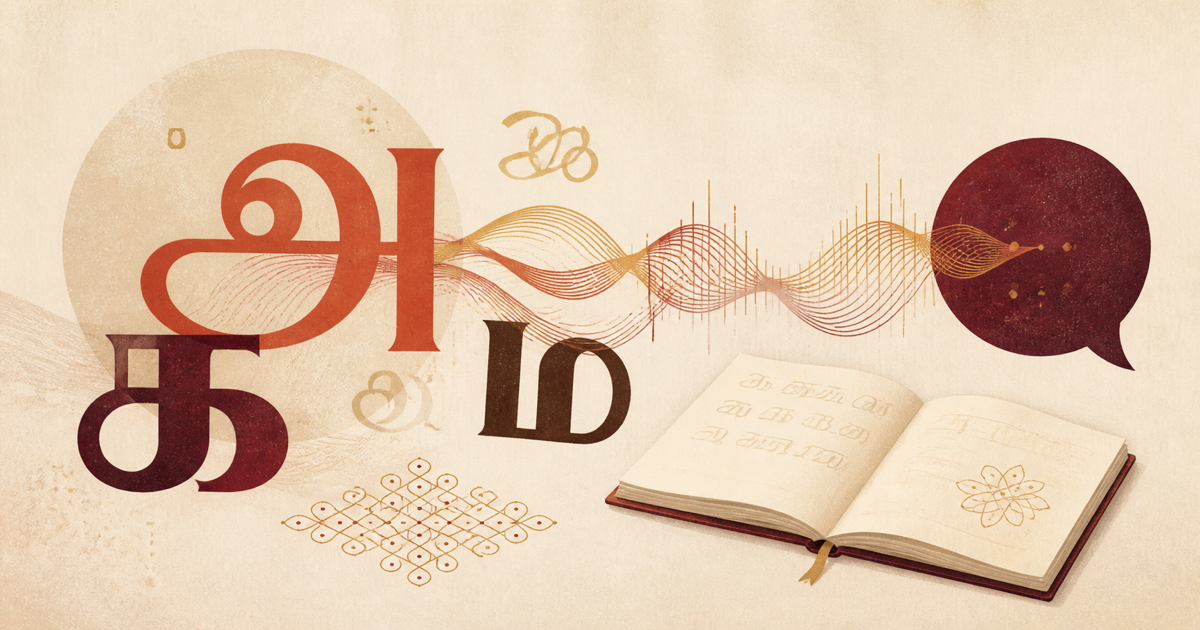
The strongest route into Tamil combines four strands from the beginning: accurate sound categories, gradual script recognition, useful spoken sentences and an explicit understanding that formal written Tamil differs from everyday speech. Start with one respectful spoken variety, read a small amount every day and organise practice around situations you genuinely need. Tamil is not one undifferentiated code, so a good plan identifies the region, community and register behind every model instead of treating variation as error.
At a glance
undefined
undefined
undefined
undefined
Define the Tamil you need
Tamil connects communities across Tamil Nadu, Sri Lanka, Singapore, Malaysia and a large global diaspora. Shared literacy matters, but pronunciation, vocabulary and ordinary speech vary. Write down who you expect to speak with, where they are from and whether your main goal is family conversation, travel, media, study or reading. That decision changes the audio models and vocabulary you should prioritise. Begin with broadly understood, respectful spoken forms, then learn to recognise important alternatives without performing a regional identity that is not yours. A clearly defined target prevents the misleading feeling that every variation must be mastered at once.
Build sound categories before speed
Tamil contrasts sounds that many learners initially merge, including dental and retroflex consonants and short versus long vowels. Meaning can depend on those distinctions. Listen to one contrast at a time, imitate a whole word, then place it inside a short phrase. Record yourself only after you can hear the difference reliably. Romanisation is useful as a temporary map, but it hides or inconsistently represents important categories. Treat the Tamil script as a pronunciation aid: it gives stable visual identities to contrasts that English spelling cannot express cleanly. Clarity and listening accuracy matter more than an exaggerated accent.
Learn the script as a system
Tamil writing becomes more manageable when learnt as a pattern rather than a wall of symbols. First recognise independent vowels and a compact set of consonant bases. Then study how vowel signs modify those bases, grouping related forms and retrieving them from memory. Read meaningful syllables and familiar names instead of copying the full inventory repeatedly. Unicode encodes Tamil letters and signs in a defined block, but digital character order is not itself a teaching sequence. A practical sequence should be frequency-led, cumulative and tied to audio so that reading supports language rather than becoming a separate calligraphy project.
Connect spoken and written Tamil
Everyday conversation and formal written Tamil differ in systematic ways. Verb endings, pronouns, sound patterns and vocabulary may change, and subtitles or news language can feel distant from family speech. Do not label one side correct and the other broken. Store paired examples with their context: a respectful spoken sentence for interaction and a written equivalent for recognition. Beginners usually need spoken comprehension first, while literacy grows alongside it in smaller doses. Later, register awareness becomes an advantage because you can choose language appropriate to messages, public information, stories, presentations and intimate conversation.
Acquire grammar through reusable frames
Tamil commonly places the verb near the end and uses case marking and verb morphology to express relationships that English often handles with word order or separate words. Learn grammar through complete, adaptable sentences: I need this, I went there, I am speaking with them, can you help me? Change one element at a time and notice what remains stable. Add tense, negation, politeness and case forms only when they unlock a communicative need. Tables can clarify patterns after exposure, but memorising endings without retrieving whole sentences rarely produces fluent speech. Each new structure should appear in listening, reading and a personally relevant response.
Turn input into real interaction
Choose short audio from the variety you are targeting and work deeply: predict, listen, check, shadow and retell. A thirty-second exchange understood well is more valuable than an hour of background audio. Prepare complete interaction chains for greetings, family, food, directions, transport, shopping and calls, including likely replies and a clarification phrase. Ask conversation partners to correct errors that block meaning or recur, not every possible refinement. Keep a weekly evidence log containing one recording, one small reading sample and the situations that still fail. That evidence tells you what to practise next far better than an abstract streak.
Put this guide to work
A twelve-week Tamil learning cycle
Use this as a loop, adapting the audio and vocabulary to your target community rather than treating it as a universal syllabus.
- Weeks 1–3: establish vowel length, dental–retroflex awareness, greetings, repair phrases, independent vowels and frequent consonant bases.
- Weeks 4–6: combine vowel signs with consonants, build present and past sentence frames and rehearse two complete daily-life exchanges.
- Weeks 7–9: compare spoken and written pairs, deepen local listening and add case-marked phrases for people, places, possession and tools.
- Weeks 10–12: complete weekly conversations, read short authentic text with support and retell familiar material without a script.
Questions learners ask
Frequently asked questions
Is Tamil difficult to learn?
Tamil asks many English-speaking learners to build new sound, script and grammar categories, but each system is learnable when introduced in a deliberate sequence. Difficulty falls when your target variety and use cases are clear.
Should I learn spoken or written Tamil first?
Prioritise the form required by your immediate goal, but do not ignore the other. Most conversation-led beginners need spoken Tamil first with gradual literacy and explicit spoken–written comparisons.
Can I learn Tamil without the script?
You can begin speaking with audio and temporary romanisation, but the script improves pronunciation, dictionary use, reading and long-term independence. Start it early in small, cumulative steps.
Which Tamil dialect should I learn?
Choose respectful, broadly understood models from the community you expect to interact with. Learn to recognise important alternatives before trying to reproduce every regional feature.
Primary sources
Official sources used for this guide
Open these pages again before making a time-sensitive registration, payment or application decision.